© 2024 Holocaust Memorial Partnership. All rights reserved.

Holocaust Memorial Partnership — Holocaust education
Holocaust universalism does not mean that all genocides are the same. It means recognizing the recurring processes that can lead societies toward genocide — while understanding that every genocide remains historically distinct. And the Holocaust itself was, without doubt, a unique and unprecedented event in history.
Holocaust Memorial Partnership
Modern Holocaust Universalism is the approach that recognizes the Holocaust as a historically exceptional and unprecedented event: the systematic attempt by Nazi Germany to annihilate European Jewry in its entirety. Its uniqueness must not be diluted, generalized, or detached from antisemitism, Nazi racial ideology, and the specific fate of the Jewish victims.
At the same time, the Holocaust can be understood not only as a singular event, but also as a process. The mechanisms that made it possible were not unique to Nazi Germany. Dehumanization, exclusion, the gradual removal of rights, propaganda, the construction of an internal enemy, bureaucratic participation, conformity, diffusion of responsibility, institutional collapse, indifference, and the normalization of violence recur in many other genocides, mass atrocities, and systems of persecution.
Modern Holocaust Universalism therefore distinguishes between the uniqueness of the event and the repeatability of its mechanisms.
It does not claim that every genocide is another Holocaust, nor does it equate different historical experiences. Rather, it argues that the Holocaust provides an exceptionally well-documented case through which we can study how modern societies can move from prejudice and exclusion to organized mass violence.
Its central principle can be expressed simply:
The Holocaust was unique in its history, but many of the mechanisms that made it possible are universal and repeatable.
For this reason, Holocaust education should preserve the historical particularity of the Jewish catastrophe while using its processes as a framework for recognizing warning signs, understanding other genocides and mass atrocities, and strengthening individual, institutional, and societal responsibility.
In this sense, the universal value of the Holocaust lies not in turning Auschwitz into a metaphor for every injustice, but in using the precise history of Auschwitz to better understand the recurring mechanisms through which human beings and institutions become capable of persecution, mass violence, and genocide.
Auschwitz remains the epicenter of the Holocaust — a place where we confront both the uniqueness of the genocide and the universal mechanisms that made it possible. It offers answers, but it also holds up a mirror to our own time. The question is whether we are willing to look into this mirror.
Auschwitz-Nova
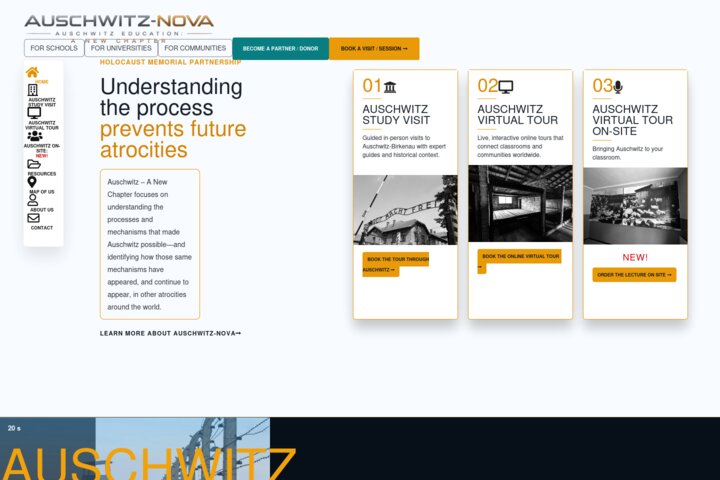 Visit the new website auschwitz-nova.com
Auschwitz-Nova is an educational and interpretive framework that treats Auschwitz as both a historically unique site and a microcosm of the wider Nazi system. Its purpose is not only to explain what happened at Auschwitz, but to use Auschwitz as a concentrated lens through which we can understand the broader processes that made both the Holocaust and Nazi mass violence possible.
Auschwitz was exceptional because it combined several functions within one system: it was a concentration camp, a site of forced labor, a place of terror and punishment, and the largest center of the mass murder of European Jews. It also existed within the wider space of
Oświęcim/Auschwitz as a model of Nazi occupation, demographic engineering, dispossession, segregation, exploitation, and attempted racial reordering.
For this reason, Auschwitz-Nova focuses on the system and the process, not only on the final act of murder.
It examines the interconnected mechanisms that made mass atrocity possible:
dehumanization and the gradual exclusion of targeted groups from the moral community;
propaganda and the construction of enemies;
the destruction of rights and legal protections;
racial ideology and antisemitism;
bureaucratic organization and administrative participation;
the role of perpetrators, collaborators, beneficiaries, bystanders, and institutions;
conformity, obedience, and the diffusion of responsibility;
Hannah Arendt’s problem of the “banality of evil” and the participation of ordinary people in extraordinary crimes;
forced labor, economic exploitation, dispossession, and technological organization;
the transformation of violence from discrimination into persecution, deportation, concentration, and ultimately mass murder;
the coexistence in Auschwitz of the concentration camp system and the machinery of extermination.
Auschwitz-Nova therefore understands Auschwitz not simply as the end point of Nazi policy, but as a place where many stages of the process can be observed together.
Its central idea is:
Auschwitz was historically unique, but many of the processes that converged there are neither unique nor confined to the past.
This is also what distinguishes Auschwitz-Nova as an educational approach. It does not avoid carefully constructed comparisons with the present. It asks whether mechanisms visible in the history of Auschwitz — dehumanizing language, radicalization, erosion of legal safeguards, political violence, scapegoating, attacks on institutions, normalization of exclusion, and the gradual acceptance of cruelty — can also appear in contemporary societies.
Such comparisons do not mean that every contemporary crisis is another Holocaust, nor that every injustice leads to genocide. Their purpose is precisely the opposite: to identify dangerous processes before they reach the point of mass atrocity.
The most important lesson of Auschwitz-Nova is therefore not simply remembrance.
It is prevention.
Auschwitz teaches us what can happen when destructive processes are allowed to develop step by step until violence becomes normalized, institutions become complicit, and human beings are transformed into categories that can be excluded, exploited, deported, or killed.
The lesson is therefore not only:
“Never again Auschwitz.”
It is:
Recognize the process before Auschwitz becomes possible.
Auschwitz-Nova seeks to make Auschwitz a framework for understanding not only the Holocaust and the Nazi system, but also the broader conditions under which genocide, crimes against humanity, and other forms of organized mass violence can emerge.
Its educational goal is to move from memory to understanding, from understanding to recognition, and from recognition to prevention.
Our offer consists of three complementary educational experiences:
- Auschwitz Study Visit
- Auschwitz Virtual Tour
(online)
- Auschwitz Virtual Tour
(in your classrom)
Holocaust Memorial Partnership | Dr. Jerzy Wójcik
Auschwitz STUDY ViSIT
on call
In 2016, we began organizing Premium visits from Kraków to the Auschwitz Museum, offering an extended experience of the former camp, including a 5–6-hour study tour. We provide the comfort of a private visit or a small-group format, access to additional exhibition blocks, and a 45-minute comfortable break during the program. We guarantee the highest standard of guiding, delivered exclusively by a carefully selected group of licensed Auschwitz Museum guides. In most cases, I conduct the tour personally.
A guided study visit with historical depth
A visit to Auschwitz is not a routine tour. It is an encounter with evidence, memory and responsibility. This premium study visit is designed for people who want a slower, more contextual and better prepared experience at Auschwitz I and Auschwitz II-Birkenau.
The format works for families, individual visitors, small groups, schools, universities, institutions and delegations preparing a commemorative or educational visit.
What the visit can include
- Prearranged visit for individuals, families, small groups or organized groups.
- Transportation options from Krakow, including private vans, minibuses or coach transport depending on the group.
- Courier or group coordinator who supports logistics and provides background information.
- A guided study tour of Auschwitz-Birkenau led by a licensed educator.
- Time for questions, reflection and a more comprehensive route than a basic short visit.
Sample schedule
- 08:30 Departure from the hotel
- 10:00 Start of the guided visit
- Auschwitz I Blocks 4, 5, 8, 9, 11 and 27, followed by the gas chamber
- Break Short pause before continuing the visit
- Auschwitz II-Birkenau Wooden barracks and Judenrampe
- Final route Ruins of crematoria II, III, IV and V
Why a study tour?
A standard visit often leaves little time for context. A study visit creates space for explanation: how the Nazi camp system functioned, how deportations and selections were organized, how evidence is preserved, and how the history of Auschwitz should be taught without simplification.
Auschwitz I
The first part of the visit focuses on the museum exhibition and original camp buildings. Depending on the program, the route may include blocks connected with prisoner life, the extermination of European Jews, personal belongings of victims, Block 11, selected national exhibitions and the first gas chamber and crematorium.
Important exhibition spaces can help visitors understand selection, forced labor, camp terror, the theft of personal belongings, and the first stages of mass extermination at Auschwitz.
Auschwitz II-Birkenau
Birkenau is an extensive authentic site where most victims of the Auschwitz-Birkenau extermination center were murdered. The visit usually includes the railway ramp, barracks, the selection area, memorial spaces and the ruins of gas chambers and crematoria.
The scale of Birkenau changes the way visitors understand Auschwitz. It is not only a historical site, but a preserved landscape of deportation, forced labor, mass murder and memory.
Logistics and timing
The study visit is usually planned as a 4-5 hour educational route at the Memorial. With transportation from Krakow and return, the whole program may take most of the day. The exact timing and route should be agreed in advance according to group size, educational goals and availability.
Educational approach
The emphasis is on accuracy, dignity and context. The visit should become a form of commemoration, historical learning and civic responsibility rather than a quick sightseeing experience.
Auschwitz is a lesson for all of us: a warning about how societies can move toward authoritarian and brutal solutions when indifference becomes normal.
Planning a visit
For a real booking flow, this popup can later be connected with a contact form, availability calendar or CRM. The full article remains in Joomla as the source page for SEO and editorial management, while the popup gives visitors the complete readable experience without leaving the home page.
Contact: info@memorialpartnership.pl
public session
06/09
Auschwitz Virtual Tour
| Public session | free of charge | Educator: Dr. Jerzy Wojcik | date: September 6, 2026, 6:00pm EST | please register here...
Our clients
Auschwitz Virtual Tours are designed for diverse audiences — from young students to business leaders.

November 2026
Dachau - Understanding the Nazi Structure (Coming soon...)
Young & adult studentsAge-appropriate live sessions for school, college and adult learners, with clear historical context and space for questions.Teachers & educatorsPrograms that support classroom preparation, deepen interpretation and help educators teach Auschwitz without simplification.Business LeadersReflective sessions for leadership groups focused on responsibility, institutions, decision-making and the consequences of indifference.Politicians & PolicymakersHistorically grounded briefings for public leaders on exclusion, propaganda, institutions and the civic lessons of the Holocaust.Military & SecuritySpecialized learning for security and uniformed services on obedience, authority, ethics and responsibility under pressure.Media & JournalismSessions for media professionals exploring language, propaganda, public narratives and the role of information in mass violence.Public AdministrationPrograms for public institutions on bureaucracy, participation, law, accountability and the administrative mechanisms of persecution.
Historic Journey
December 2026
Beyond Auschwitz - Operation Reinhardt: Extermination of Polish Jews (Coming soon...)
the message
About Us
Holocaust Memorial Partnership was established in 2015 with a specialization in organizing educational visits to Auschwitz and other sites associated with the Holocaust. Since 2020, we have primarily focused on virtual sessions dedicated to Auschwitz and other relevant topics related to the Holocaust. The Partnership comprises independent educators who have devoted years to teaching and lecturing about the Holocaust. We operate independently, yet maintain ongoing collaborations with various institutions, organizations, schools, colleges, and universities.